How to Find a Quick AC Repair Technician Near You
How to Find a Quick AC Repair Technician Near You
In Phoenix, a broken air conditioner is rarely a minor inconvenience. By early morning in July, indoor temperatures can already be climbing into an unsafe range, especially for infants, older adults, and anyone with health conditions. That is why the search for Emergency AC Repair usually starts with urgency, not curiosity. People in Arcadia, Ahwatukee, Biltmore, Desert Ridge, Maryvale, and North Phoenix are usually looking for the same thing: a technician who can reach the property quickly, diagnose the problem correctly, and present a real price before work starts.
Phoenix creates conditions that make fast diagnosis more important than in most U.S. Cities. The region sits in ASHRAE climate zone 2B, which is hot and dry, with design cooling temperatures in the 110 to 117 degree range depending on elevation and neighborhood. On west-facing equipment pads near South Mountain Park, along I-10 corridors, and across exposed subdivisions in 85044, 85048, and 85050, afternoon surface temperatures at the outdoor condensing unit can reach roughly 130 to 140 degrees. That level of sustained heat puts heavy stress on the run capacitor, which is the cylindrical electrical component inside the outdoor unit that stores and releases the energy pulse needed to start the compressor and fan motor each time the system cycles on. It also raises the failure rate of contactors, fan motors, and compressors across Maricopa County every summer.
For that reason, Emergency AC Repair in Phoenix is less about finding the first company that answers the phone and more about finding one that knows the local failure patterns, has dispatch capacity across the Valley, and sends a technician trained to test instead of guess. The right company should understand monsoon dust, refrigerant issues, duct leakage in mid-century homes, thermostat faults, frozen evaporator coils, and the growing impact of the 2026 R-454B refrigerant transition on repair decisions for older R-410A systems.
What “quick” should mean in Phoenix
Homeowners often use “quick” to mean fast arrival, but in HVAC repair it means more than a truck reaching the driveway. A quick repair experience has three parts. The dispatch has to move fast. The technician has to identify the fault without trial-and-error parts swapping. The repair has to restore real cooling capacity, not just restart the system for a few hours. A unit that blows cool air for one cycle and fails again by evening was never truly repaired.
That matters in Phoenix neighborhoods like Camelback East and Arcadia 85018, where many homes still have aging duct systems and older air handlers tucked into attic spaces that reach extreme temperatures by midday. It also matters in newer Desert Ridge homes, where high-efficiency systems use more control logic, more sensors, and tighter refrigerant charging tolerances. Emergency AC Repair that is genuinely fast has to match the equipment type, the home age, and the actual stress conditions at the property.
A reliable company should also understand that speed without structure creates mistakes. A technician who arrives quickly but skips electrical testing, ignores coil condition, or adds refrigerant without verifying the charge can leave the homeowner paying twice. Strong Emergency AC Repair work in Phoenix depends on a disciplined diagnostic process. That is what separates a credible HVAC contractor from a company that is just chasing summer volume.
Why Phoenix AC systems fail so often in peak season
Phoenix summers produce a pattern of failures that experienced local technicians recognize immediately. The most common is run capacitor failure. Under repeated high-heat starts, the internal dielectric material in the capacitor degrades, and the component can no longer deliver the stored electrical push that starts the compressor or condenser fan motor. The homeowner hears a hum, the system struggles to start, or the outdoor unit stops entirely while indoor temperatures rise.
The second common issue is condenser coil fouling. The condenser coil is the outdoor heat-releasing coil that must stay open to airflow so the refrigerant can dump indoor heat outside. During June through September, haboob dust events and monsoon wind carry caliche fines that pack into the coil surface. In Phoenix, that buildup can reduce cooling capacity by roughly 15 to 25 percent until the coil is cleaned. That is one of the more surprising local facts many homeowners do not hear until a technician shows them the blocked coil in person. In practical terms, the system may still run, but it runs hotter, longer, and with more compressor stress.
Refrigerant leaks are also common, especially at the evaporator coil or the TXV valve, which is the thermostatic expansion valve that meters refrigerant flow into the indoor coil. When charge falls too low, the evaporator coil can freeze, airflow drops, and the vents start pushing weak or warm air. In older R-410A systems, especially units installed in the mid-2010s, repair decisions now carry another layer because the January 1, 2026 R-454B transition ended new R-410A system manufacturing under the EPA SNAP rule. Existing R-410A equipment can still be serviced, but the long-term cost picture has changed, and any company providing Emergency AC Repair in Phoenix should be able to explain that clearly.
Then there is duct leakage. In Biltmore 85016 and parts of Encanto and North Central Phoenix, many homes built from the 1950s through the 1970s still have original ductwork in vented attics. Day & Night Air Conditioning, Heating & Plumbing regularly sees supply air losses in the 35 percent range in these homes. That means more than a third of conditioned air can leak into the attic before it ever reaches the living space. In that situation, the AC may not be “broken” in the strictest sense, yet the homeowner still experiences an emergency because the house cannot cool.
What a real diagnostic process looks like
When people search for ac repair near me, they are usually hoping the company can identify the fault on the first visit. That depends on whether the technician uses actual field testing. In Phoenix, credible Emergency AC Repair starts with confirming the symptom, then testing the system in sequence.
- The thermostat is verified for power, calibration, and call for cooling.
- The air filter, blower operation, and evaporator airflow are checked for restriction.
- The outdoor electrical components, especially the run capacitor and contactor, are tested with meters.
- The condenser coil condition and fan performance are inspected for heat rejection problems.
- The refrigerant charge is verified through pressure and temperature readings, including superheat and subcooling where the equipment requires it.
That sequence matters. If the blower motor is weak, adding refrigerant will not fix the problem. If the contactor is pitted and failing to pass current reliably, replacing the thermostat will not help. If the condenser coil is packed with monsoon dust, the compressor may overheat even though the electrical parts test fine. Emergency AC Repair is supposed to remove uncertainty, not pile more onto the invoice.
Another sign of serious diagnostic work is plain-language explanation. A homeowner should hear what failed, why it failed, and how the repair affects the rest of the system. If the run capacitor is bad, the explanation should connect it to Phoenix heat stress. If the coil is dirty, the technician should explain the capacity loss and compressor strain. If the refrigerant charge is low, the homeowner should hear that refrigerant is not consumed like fuel and that a low charge usually points to a leak. This is what separates skilled air conditioning repair from a rushed seasonal service call.
Licensing and training matter more in 2026 than they did a few years ago
Arizona requires the right licensure for legal residential HVAC and plumbing work. For cooling service, the important credential is the Arizona ROC C-39 Air Conditioning and Refrigeration License. In integrated service companies, plumbing work also requires the Arizona ROC C-37 Plumbing License. The distinction matters because many comfort issues overlap systems. A Visit this site clogged condensate drain line, a failed float switch, or a nearby water heater leak can affect the air handler area and change the service picture.
Refrigerant handling is another major issue. Any company offering Emergency AC Repair should be using EPA Section 608 certified technicians. In 2026, that baseline is no longer enough by itself. New equipment is shifting to refrigerant R-454B, which is an A2L mildly flammable refrigerant with a global warming potential of 466, compared with R-410A at 2,088. That shift requires updated training, leak detection equipment, and awareness of indoor concentration thresholds. Phoenix homeowners do not need a chemistry lecture, but they do need to know whether the technician in the driveway is trained for the equipment market that now exists.
A company that handles both legacy R-410A systems and new R-454B equipment can usually give a more honest answer about repair versus replacement. That is relevant even on an Emergency AC Repair call, because some failures happen on systems that are already near the end of service life. If the compressor has failed on an older undersized or poorly maintained unit, the homeowner deserves a factual discussion of the economics, not pressure or vague language.
Why local knowledge changes the outcome
Phoenix is large enough that technicians can lose time if they do not know the service area well. A company with Valley-wide coverage should understand the driving patterns around Loop 202, I-17, Loop 101, and the Sky Harbor corridor so dispatches do not drift into broad arrival windows that mean little in an emergency. More importantly, local knowledge shows up in diagnosis.
In Ahwatukee Foothills 85044 and 85048, many homes have systems exposed to intense west sun and long late-afternoon run cycles. In Arcadia and Biltmore, older homes often combine aging ductwork with additions or remodels that changed the room load without changing the system design. In Maryvale 85033, many older split systems are still operating on equipment near the end of their expected life. In North Phoenix and Paradise Valley Village, larger homes may have multiple systems, and the real emergency can be isolated to one zone or one air handler rather than the whole house.
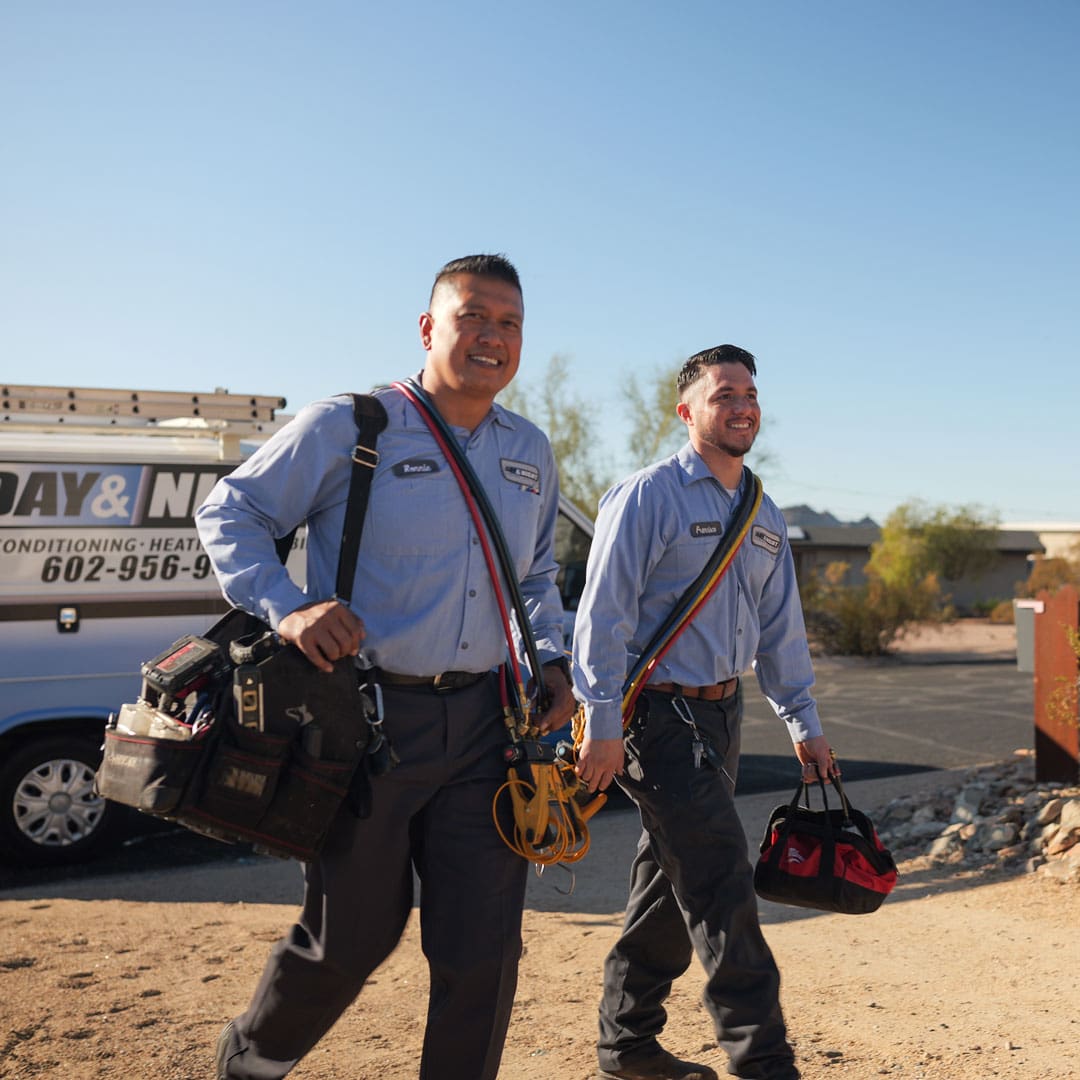
That context affects what “quick” means. A local technician may already suspect capacitor failure after hearing the symptom and neighborhood context in mid-July. They may expect coil fouling right after a dust storm. They may notice that a five-ton unit installed by square-footage guesswork is short cycling because the home was never sized using Manual J, the ACCA load calculation method that accounts for solar gain, insulation, window area, infiltration, and orientation. In Phoenix, rule-of-thumb sizing misses too much. A company doing strong Emergency AC Repair work should be able to spot when the system problem is actually tied to poor original design.
Warning signs that the company may not be the right one
Homeowners looking for Emergency AC Repair often have only a few minutes to evaluate a company. A few warning signs can still tell a lot. One is a promise of a repair price before diagnosis. Another is vague language about “probably low freon” before anyone has measured anything. Another is a company that cannot explain whether it services both R-410A and R-454B equipment, or whether its technicians hold EPA Section 608 certification.
It is also worth noticing whether the company explains pricing structure before dispatch. Phoenix homeowners dealing with after-hours failures need clarity about whether the firm uses upfront flat-rate pricing or hourly billing that keeps rising while the problem is being figured out. A company should also be able to explain service scope. If the issue turns out to involve duct leakage, thermostat controls, airflow imbalance, or even nearby condensate drainage and plumbing concerns, the homeowner should not be left coordinating multiple contractors if one capable firm can address the full picture.
Another red flag is an immediate push into ac installation without a credible repair diagnosis. Replacement is sometimes the right answer, especially if the compressor is failed on an aging R-410A unit with multiple existing issues. But a trustworthy company does not skip the testing process that justifies that recommendation. In Phoenix, homeowners hear replacement pitches every summer. They hear fewer honest explanations.
What Phoenix homeowners should expect on the first visit
A serious Emergency AC Repair call should produce answers on the first visit even if the final decision is still pending. The homeowner should know whether the system failed because of an electrical component, airflow restriction, refrigerant issue, coil condition, control fault, or mechanical failure. They should know whether the unit can be repaired that day, whether a return visit is needed, and whether the repair makes sense relative to the age HVAC company in Maricopa County AZ and condition of the system.
For example, a technician may find a failed run capacitor on a system in Sunnyslope 85020 and restore cooling the same afternoon. On another call in Camelback East, the system may show low refrigerant, a dirty condenser coil, and heavy duct leakage, with the unit already struggling to maintain 78 degrees indoors at 115 outside. That second visit is still a successful Emergency AC Repair appointment if it produces a solid diagnosis and a written path forward. Fast does not always mean simple. It means the homeowner stops guessing.
The best companies also document what they see. Photos of a fouled condenser coil, meter readings on a weak capacitor, or evidence of evaporator ice help the homeowner understand the recommendation. That matters because Phoenix homes often carry long-run summer operating costs, and repair decisions affect more than comfort. A struggling system can drive high electricity bills through APS or SRP long before it completely stops.
Why Day & Night stands out in the Phoenix market
Day & Night Air Conditioning, Heating & Plumbing has worked in Phoenix since 1978 and operates from 3669 E La Salle St in 85040. That local history matters because the company has seen the full range of Maricopa County equipment and housing stock, from mid-century ranch homes in Arcadia and Biltmore to newer subdivisions near Desert Ridge and the Loop 101 corridor. It also matters because the business has the infrastructure to dispatch across the Valley when cooling failures spike.
The company holds Arizona ROC C-39 HVAC and ROC C-37 plumbing licensure, uses EPA Section 608 certified technicians, and has training for the post-2026 R-454B refrigerant market. The integrated HVAC and plumbing model is useful in real-world service because drain, condensate, and water-related issues often show up around cooling equipment. Armstrong Plumbing joined Day & Night in March 2026, which expanded plumbing capacity across the Phoenix Valley and strengthened that combined service approach.
Day & Night also brings trust signals that homeowners can verify. The company has a 4.9 star Google rating across more than 9,400 verified reviews, a Google Guaranteed badge, BBB A+ accreditation, NATE-certified technicians where applicable, same-day service availability for urgent repair needs, 24/7 dispatch for emergency calls, and upfront flat-rate pricing given before work begins. For a homeowner searching for Emergency AC Repair, that combination matters because it speaks to both capacity and accountability.
Anyone comparing local options can review the company’s AC repair service page here: Phoenix air conditioning repair. The point is not that every system needs the same answer. The point is that the company has long-standing local depth and the operational scale to respond when Phoenix weather puts real pressure on households.
How repair decisions connect to larger system issues
Many emergency calls reveal bigger system problems that have been building for months or years. A failed capacitor may be the immediate trigger, but the underlying condition may be a condenser coil caked with dust, a starved return duct, or an oversized unit that short cycles because the house was never properly load-calculated. Phoenix homes continue to suffer from square-footage sizing estimates even though Manual J has long been the correct method. Poor sizing contributes to compressor wear, humidity issues during monsoon season, and uneven room temperatures.
That is why the best Emergency AC Repair companies do more than replace a failed part. They look at why the part failed and whether the system is operating inside normal conditions. If the answer is no, the homeowner gets context instead of a bandage. That context may involve discussing duct sealing, thermostat control updates, maintenance frequency, or replacement timing for an older R-410A system that no longer makes financial sense to keep reviving.
Even when replacement enters the conversation, the standard should remain technical and local. In Phoenix, any new split system under 45,000 BTU must meet the 2026 Southwest minimum of 14.3 SEER2 and 11.7 EER2, with many homeowners choosing 15+ SEER2 or higher depending on run hours and budget. Proper equipment selection should follow Manual J, Manual S, and where needed Manual D duct design. If a contractor discussing repair cannot explain why the existing system struggles in Phoenix conditions, that same contractor is unlikely to size a replacement properly either.
What separates a map-pack listing from a real service company
Search results can make several companies look similar. Everyone claims fast service. Everyone claims experience. The difference usually appears in details. Real companies publish an address, maintain active local reviews, show actual service pages, and explain credentials that matter in Arizona. They know the difference between a diagnostic fee and a repair quote. They know what neighborhoods they cover and can talk about conditions from South Mountain to North Phoenix without sounding generic.
A real Phoenix HVAC company should also be able to discuss the shift from legacy Refrigerant R-410A to Refrigerant R-454B without confusion, because that change affects current repair strategy. It should understand monsoon dust on condenser coils, the outdoor pad heat load seen across Maricopa County, and the fact that many homeowners searching ac repair phoenix are dealing with repeated failures tied to neglected maintenance or old duct systems, not random bad luck.
- Local address and Phoenix service history
- Arizona ROC C-39 license and EPA Section 608 certification
- 24/7 emergency dispatch with same-day repair availability
- Written upfront flat-rate pricing before repair work starts
- Clear explanation of diagnosis in plain language
Those signals are more useful than slogans. They help a homeowner separate a real local operator from a broad lead-generation listing that may hand the job to whoever is available.
Finding the right technician before the house overheats further
The strongest approach is to choose the company based on diagnostic credibility, local depth, and dispatch ability, then let the field findings drive the repair decision. In Phoenix, hesitation carries a cost. A system that is short cycling in the morning can be fully locked out by mid-afternoon. A condenser fan motor that is slowing down can push a compressor into dangerous operating temperatures. A blocked condensate drain can trip a float switch and shut the system down entirely while the homeowner assumes the thermostat is the issue.
Emergency AC Repair is therefore a timing issue and a quality issue at the same time. The technician needs to arrive quickly, but the visit also needs to settle the problem with evidence. That means testing the run capacitor instead of guessing, inspecting the contactor instead of assuming, checking the condenser coil instead of ignoring dust load, and verifying refrigerant charge rather than treating low cooling as a generic symptom. In Phoenix, where summer equipment stress is relentless, that discipline is what keeps a repair from turning into a repeat emergency.
For homeowners and business owners in Phoenix and throughout Maricopa County who need Emergency AC Repair, Day & Night Air Conditioning, Heating & Plumbing remains one of the most established local options. The company has served the Valley since 1978 from 3669 E La Salle St, Phoenix, AZ 85040, holds Arizona ROC C-39 HVAC and ROC C-37 plumbing licenses, uses EPA Section 608 certified technicians with R-454B transition training, and provides 24/7 emergency service with same-day availability for urgent cooling failures. Day & Night also offers upfront flat-rate pricing before work begins and maintains a 4.9 star Google rating across 9,400+ verified reviews. Homeowners who need Emergency AC Repair now can call (602) 492-9656 to request service.
Phoenix, AZ 85040